How to Connect Your Robinhood Account to Google Sheets
Track your Robinhood portfolio in Google Sheets! With SheetsFinance for Google Sheets, you can now connect your Robinhood account directly to Google Sheets and access all your portfolio data in real-time.
Robinhood has made investing accessible to millions of users with its commission-free trading and user-friendly app. Now you can take your Robinhood investing to the next level by bringing your portfolio data into Google Sheets, where you can build custom analysis, track performance, collaborate with others, and create powerful visualizations.
Robinhood connection details
What we'll cover
- What data you can access from your Robinhood account
- Step-by-step guide to connecting Robinhood to Google Sheets
- How to use the
SF_BROKERAGE()function to pull your data - Example use cases and formulas
- Privacy and security information
📊 What Robinhood Data Can You Access?
Once connected, SheetsFinance allows you to pull the following data from your Robinhood account directly into Google Sheets:
- Holdings - Current stock and ETF positions including symbol, quantity, cost basis, current value, and unrealized gains/losses
- Transactions - Complete transaction history including buys, sells, dividends, and fees
- Orders - Recent orders and their status (filled, pending, cancelled)
- Balances - Account balance, cash position, and buying power
- Options Positions - Options contracts including strike price, expiration, and P&L (if you have options trading enabled)
All data syncs in real-time, so you'll always have an up-to-date view of your Robinhood portfolio right inside Google Sheets.
🔐 How to Connect Your Robinhood Account to Google Sheets
Prerequisites
Before you begin, make sure you have:
- A SheetsFinance account with an active brokerage subscription
- SheetsFinance installed in Google Sheets (installation guide)
- Your Robinhood account login credentials
💡 Free Trial: New users get a 15-day free trial of the brokerage features, no payment details required!
Step 1: Purchase or Start Your Brokerage Trial
- Visit the SheetsFinance Pricing Page
- Select a brokerage plan or start your free trial
- Complete the checkout process
Step 2: Connect Robinhood on the SheetsFinance Website
- Log into your SheetsFinance Account Dashboard
- Navigate to the Brokerage tab
- Click Connect under "Create New Connection"
- Search for and select Robinhood from the list of brokers
- You'll be redirected to Robinhood's secure login page
- Enter your Robinhood username and password
- Complete any two-factor authentication (you may receive a code via SMS or email)
- Authorise SheetsFinance and our brokerage connections provider SnapTrade to access your account data (read-only)
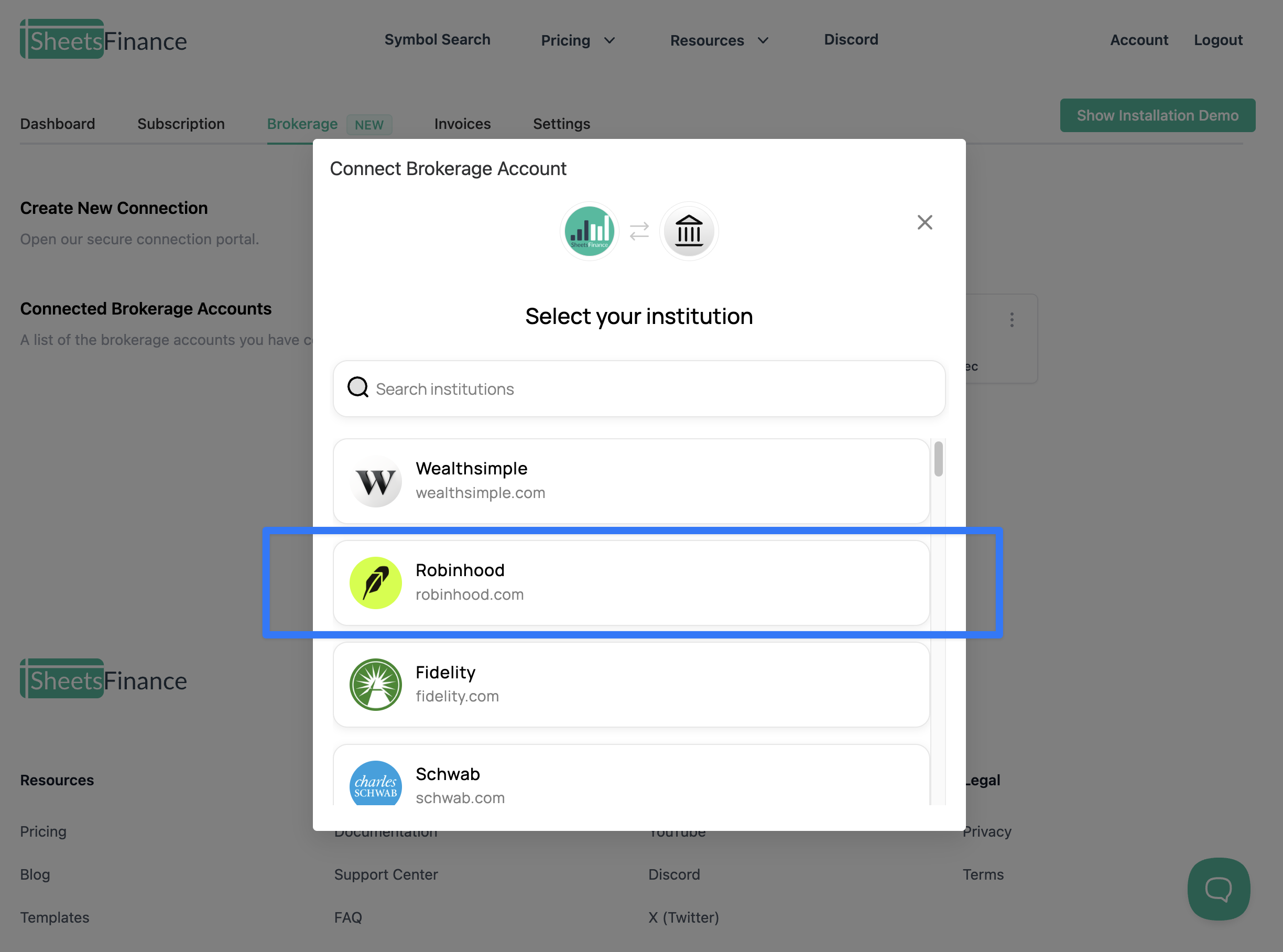
Once connected, you'll see your Robinhood account listed in your Connected Brokerage Accounts section.
Step 3: Set a Nickname for Your Robinhood Account
An account nickname is a custom label you assign to your Robinhood account connection. This nickname is used in Google Sheets formulas to reference your account when pulling data.
SheetsFinance will set a default nickname based on the institution name, in this case, "robinhood". If you have multiple Robinhood accounts then the default nicknames will begin with the institution name, in this case "robinhood", and end with a unique identifier (e.g., "robinhood_1234"). You can keep the default nicknames or customise them to something more descriptive. This does not affect the connection in any way, it's just a label for your reference in Google Sheets.
💡 Tip: If you have multiple Robinhood accounts, use descriptive nicknames like "robinhood_main" and "robinhood_taxable" to keep them organised.
Customise your account nicknames on our website:
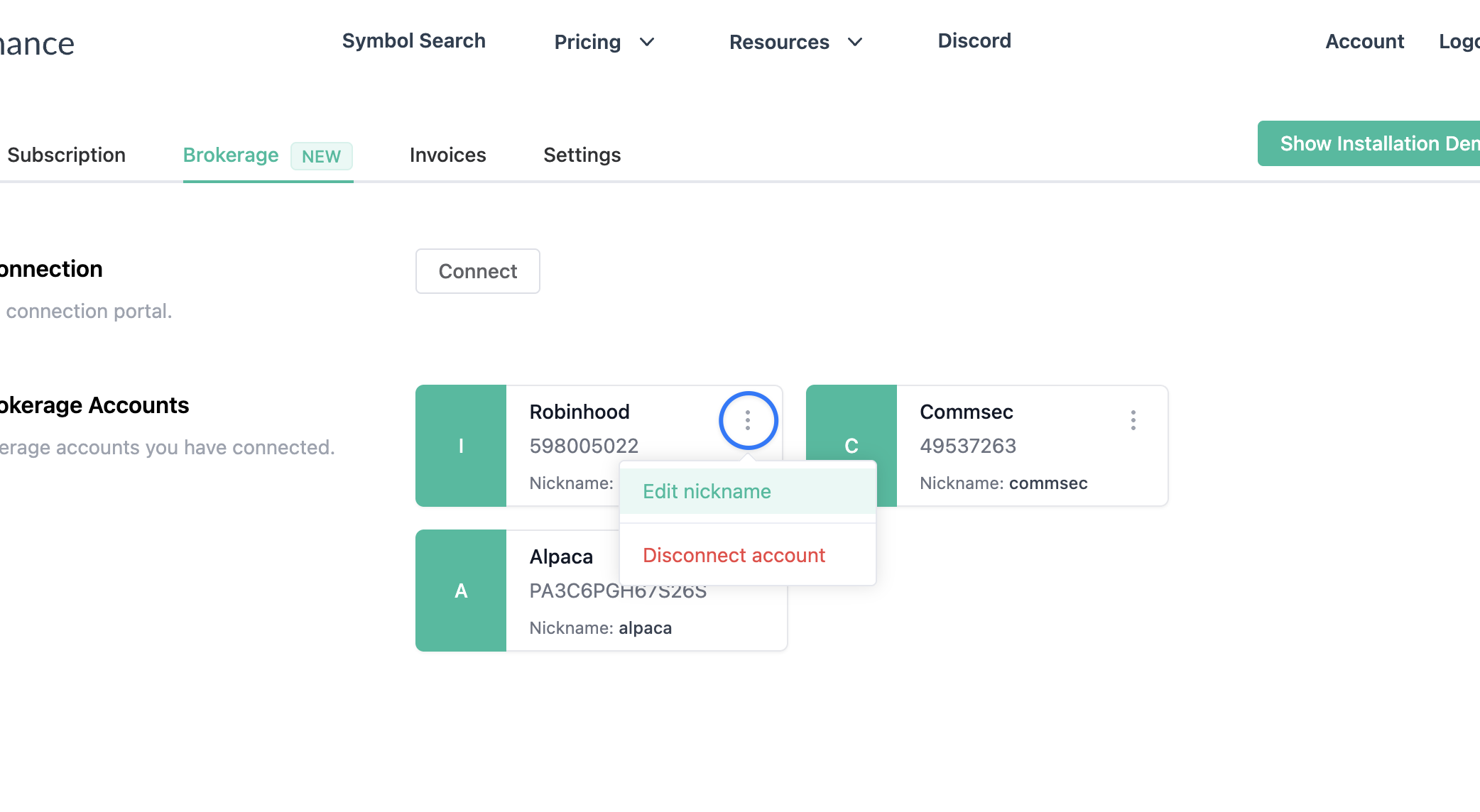
- In the Brokerage tab of your account dashboard, find your Robinhood connection
- Click Edit Nickname
- Enter a custom nickname (e.g., "rh", "robinhood_main", etc.)
- Click Save
Customise your account nicknames in Google Sheets:
- Open Google Sheets
- Go to Extensions > SheetsFinance > Brokerage
- The Brokerage sidebar will open showing your connected accounts
- Click the pencil icon next to your Robinhood account
- Enter a custom nickname and click Save
Step 4: Enable Brokerage in Your Google Sheet
Due to the sensitive nature of brokerage data, you need to explicitly enable brokerage for each Google Sheet where you want to use it:
- Open the Google Sheet where you want to access your Robinhood data
- Go to Extensions > SheetsFinance > Brokerage
- The Brokerage sidebar will open
- Check the box "Enable Brokerage for this document"
- You should now see your Robinhood account listed

🔒 Security Note: Brokerage must be enabled individually for each sheet. This prevents accidental data exposure if you share sheets with others.
📈 Using the SF_BROKERAGE() Function
Now that your Robinhood account is connected and brokerage is enabled in your Google Sheet, you can start pulling data into Google Sheets using the SF_BROKERAGE() function.
📚 Jump to the docs: For all the detail on how to use the
SF_BROKERAGE()function head to our docs
⏰ Real-time Data: Our Robinhood integration provides real-time data. To pull in the latest information run 'Refresh Brokerage' from the dropdown menu in Google Sheets (Extensions > SheetsFinance > Refresh > Refresh Brokerage)
Basic Syntax
=SF_BROKERAGE(account_nickname, type, [metrics], [start_date], [end_date], [transaction_types])Example 1: Get Your Current Holdings
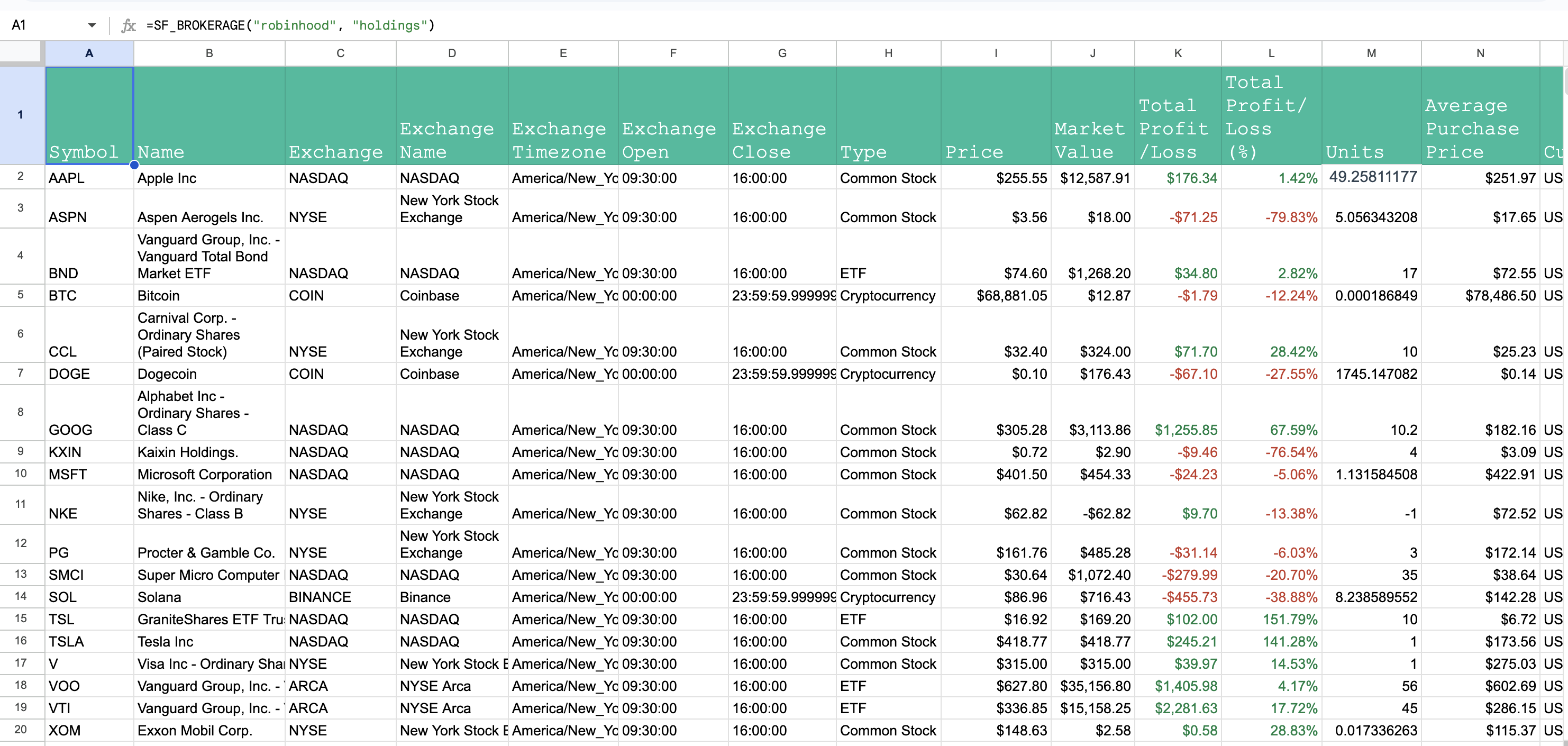
To pull all your Robinhood holdings/positions into Google Sheets, use the "holdings" type:
=SF_BROKERAGE("robinhood", "holdings")This returns a table with all your positions including:
- Symbol
- Security name
- Units
- Average cost per share
- Current price
- Market value
- Unrealized gain/loss
- Unrealized gain/loss percentage
- And more!
🤔 Where are my options positions? These are handled separately under the
"optionsPositions"type, keep reading to learn more.
Example 2: Get Specific Holding Metrics
As with all SF functions, you can use the & operator to chain together multiple metrics. This allows you to filter down to exactly that data you're after. For example, to show only symbol, units, and market value you can do the following:
=SF_BROKERAGE("robinhood", "holdings", "symbol&units&marketValue&unrealizedPL")Example 3: View Your Transaction History
Access your account transaction history with the "transactions" type:
=SF_BROKERAGE("robinhood", "transactions")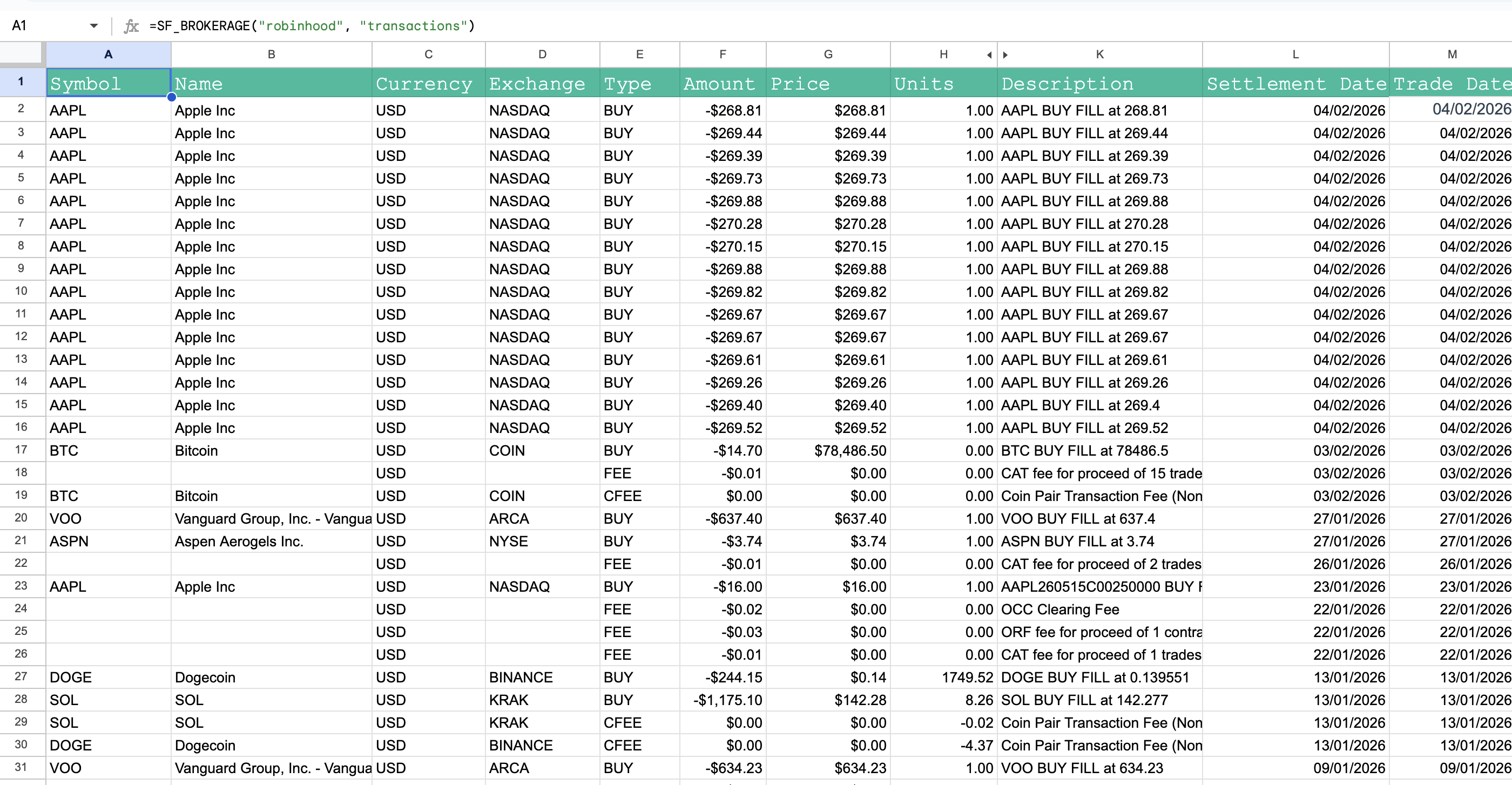
Example 4: Filter Transactions by Date and/or transaction type
The transaction type also supports the optional arguments start_date, end_date and transaction_types for more granular filtering. For example, to see all transactions from 2024:
=SF_BROKERAGE("robinhood", "transactions", "all", "2024-01-01", "2024-12-31")Or to see only buys and sells from 2024:
=SF_BROKERAGE("robinhood", "transactions", "all", "2024-01-01", "2024-12-31", "BUYS&SELLS")Example 5: Check Your Account Balances
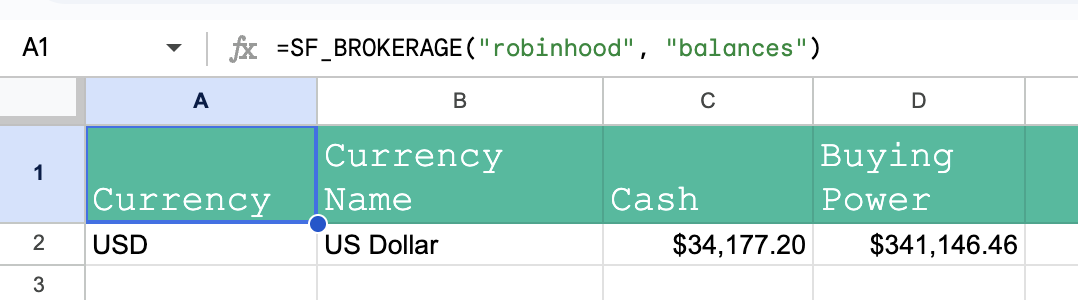
You can pull in your account balances including cash and buying power with the "balances" type:
=SF_BROKERAGE("robinhood", "balances")This shows your:
- Cash balances (per currency)
- Buying power
Example 6: View Recent Orders
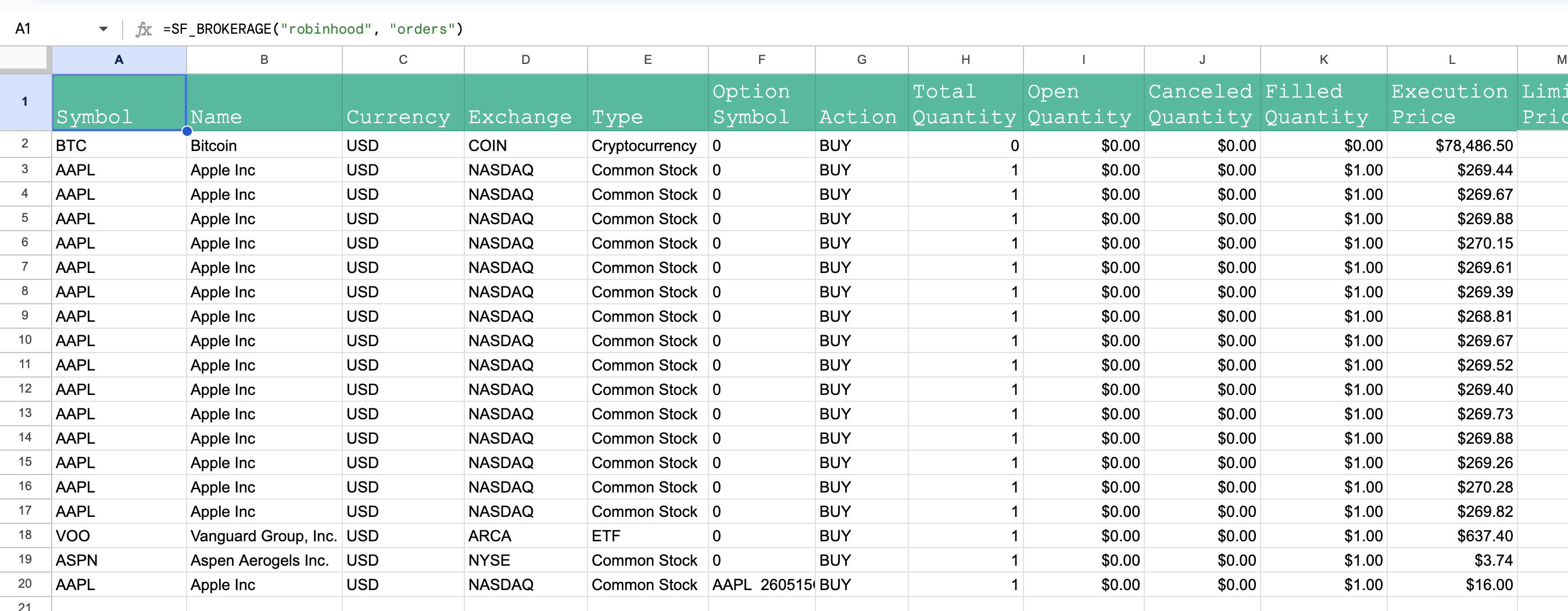
The "orders" type allows you to see your recent orders and their status:
=SF_BROKERAGE("robinhood", "orders")See your order history including:
- Order type (market, limit, stop, etc.)
- Status (filled, pending, cancelled, etc.)
- Fill price and quantity
- Timestamps
- And more!
Example 7: View Options Positions
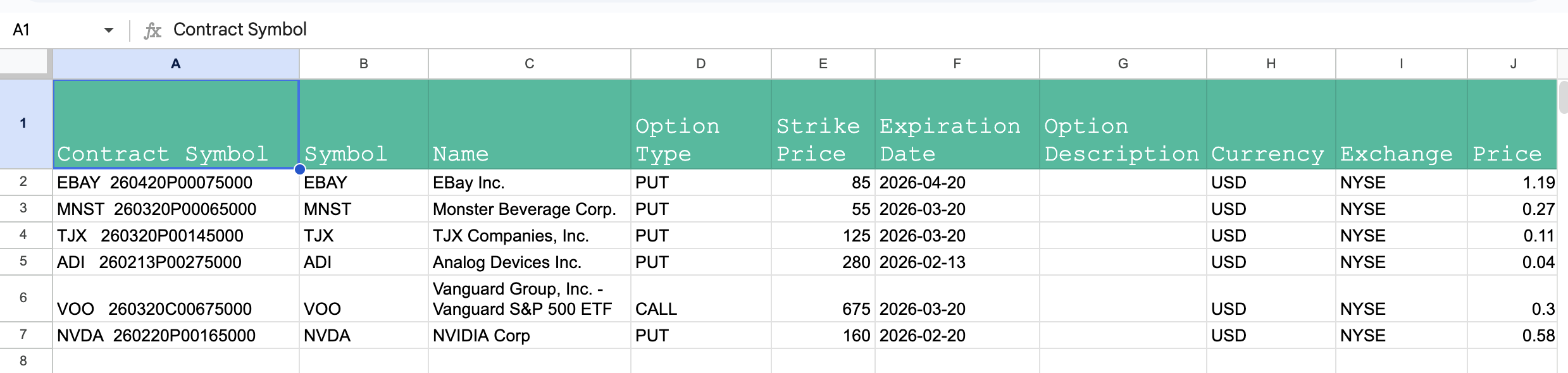
Last but not least, you can also access your options positions with the "optionsPositions" type. This is separate from the regular holdings data as options have unique attributes that need to be handled differently. To pull your options positions, use the following formula:
=SF_BROKERAGE("robinhood", "optionsPositions")This returns detailed options data including:
- Underlying symbol
- Option type (call/put)
- Strike price
- Expiration date
- P&L metrics
- And more!
💡 Practical Use Cases
1. Portfolio Performance Tracker
Create a comprehensive performance dashboard showing:
- Total portfolio value over time
- Daily/weekly/monthly returns
- Top performing stocks
- Worst performing positions
- Portfolio diversity metrics
Use Google Sheets' built-in charting tools to visualize your performance trends.
2. Dividend Income Tracker
Filter your transactions to track dividend income:
- Total dividends received by period
- Dividend income by stock
- Projected annual dividend income
- Dividend yield by position
Create charts to visualize your passive income growth over time.
3. Cost Basis and Gains Tracker
Use holdings data to monitor:
- Total unrealized gains/losses
- Best and worst performers
- Positions approaching long-term capital gains status
- Average cost per share for each position
Set up conditional formatting to highlight big winners and losers.
4. Trading Activity Analysis
Analyze your trading patterns:
- Number of trades per month
- Most frequently traded stocks
- Average hold time
- Trading frequency patterns
Use pivot tables to summarize your trading behavior.
5. Asset Allocation Monitor
Create charts showing:
- Portfolio allocation by stock (pie chart)
- Sector exposure
- Stock vs. ETF allocation
- Cash position relative to total portfolio
6. Goal Tracking
Monitor progress toward investment goals:
- Track portfolio growth toward savings targets
- Monitor specific stock position sizes
- Calculate time to reach investment milestones
- Compare actual vs. planned contributions
7. Tax Planning
Prepare for tax season by analyzing:
- Realized gains/losses for the year
- Short-term vs. long-term capital gains
- Dividend income summary
- Wash sale identification
🔒 Privacy & Security
We take the security and privacy of your Robinhood data very seriously. There are two classes of data associated with your brokerage connection:
- Brokerage Data: This is the data that is pulled in from your brokerage account(s) into Google Sheets and/or Excel.
- Brokerage Credentials: Randomised tokens that are used to authenticate your brokerage account(s) with SheetsFinance.
SheetsFinance does the following to ensure the security of your data:
- User data belongs to the user: Your Robinhood brokerage data is your own, we do not touch it without your explicit permission. Only you have access to your brokerage data.
- No Long-term Brokerage Data Storage: We do not store any of your Robinhood brokerage data in databases on our servers. The only storage medium is temporary caching in-memory whilst actively using the data in Google Sheets and/or Excel, this is to ensure best performance.
- Encrypted Brokerage Credentials: Your Robinhood brokerage credentials are encrypted, stored securely and regularly rotated. Your brokerage credentials are only valid for the server-to-server connection between SheetsFinance and brokerage providers and are useless outside of this context.
- Complete Disconnection: If you remove a brokerage connection or your entire brokerage subscription, all brokerage credentials become invalid for future use. Entirely new credentials are generated if you reconnect your Robinhood brokerage account(s).
- Read-Only Access: SheetsFinance has read-only access to your Robinhood brokerage data. We do not have the ability to execute trades or make any changes to your Robinhood brokerage account(s).
📚 Additional Resources
- Brokerage Documentation - Complete guide to brokerage connections
- SF_BROKERAGE Function Reference - Detailed function documentation
- Supported Brokers - Full list of supported brokerage firms
- Google Sheets Installation Guide - How to install SheetsFinance
🎯 Get Started Today
Ready to connect your Robinhood account to Google Sheets?
- Sign up for SheetsFinance (15-day free trial)
- Start your brokerage trial
- Connect your Robinhood account
- Start tracking your portfolio in Google Sheets!
Robinhood makes investing accessible. SheetsFinance makes it powerful. Combine them both to take control of your financial future with sophisticated portfolio analysis right in Google Sheets, with the added benefits of Google's collaboration and sharing features.
If you have any questions or need assistance, our support team is here to help.
Happy investing! 🚀📊